

Spanish from the ground up.
Learn the grammar and vocabulary that let you build your own sentences. A practice space for all Spanish learners and readers of The Adult Beginner’s Guide to Spanish.
Foundations first
Build a solid base in grammar and vocabulary.
Latin American pronunciation
Hear and practice natural, real-world Spanish.
Recall, repeat, apply
Practice often so you can use Spanish with confidence.
Where are you starting?
Choose the statement that describes what you can do today. You can revisit the foundations at any point.
Beginner
Build the foundations
Start with articles, agreement and present-tense verbs. Use them to write and say complete sentences.
Intermediate
Connect your ideas
Build on the sentences you already know. Add reasons, talk through plans and practice responding aloud.
FIND YOUR STARTING POINT
Choose your study path
Practice Lab
SER vs. ESTAR
Choose the verb the sentence needs. After each answer, you’ll see the clue that makes the difference.
Review the distinction
Use ser for identity, origin, and where an event takes place. Use estar for states and for the location of people and things.
El museo está en el centro. The museum is downtown. La reunión es en el museo. The meeting is at the museum.
Your study notebook
Read the example, cover it, and say a new sentence from memory. Then compare your sentence with the model.
BEGINNER · BOOK 1
Build a sentence
01. Articles and agreement
Learn each noun with its article. Match the adjective to the noun’s gender and number.
La casa roja. → Las casas rojas.
El libro rojo. → Los libros rojos.
Try it. Make el perro negro plural, then say both forms aloud.
Show the model
El perro negro → Los perros negros.
02. Subject pronouns and present verbs
Practice yo, tú, él, ella, usted, nosotros, nosotras, ellos, ellas, ustedes. Start with a regular verb and change the subject.
Yo trabajo en casa. Ella trabaja en casa. Ustedes trabajan en casa.
Try it. Say “We work in a library.” Use la biblioteca and the ending -amos.
Show the model
Trabajamos en una biblioteca.
03. Latin American pronunciation
Keep your vowels steady in casa, mesa, libro, foto and luna. Say c before e or i, and z, with an s sound in words like cena and zapato.
For tortilla, use a sound close to the English y in “yes” as your starting point for ll. You’ll hear regional variations.
In these examples, the unaccented words end in a vowel, n or s and take stress on the next-to-last syllable. A written accent marks stress in words like café.
Try it. Read la tortilla, la cena, el zapato twice and tap the stressed syllable.
INTERMEDIATE · BUILD ON THE BASICS
Say more with what you know
01. Give a reason and ask back
Give your answer, add one reason with porque, then return a related question.
Prefiero estudiar por la mañana porque tengo más energía. ¿A qué hora estudias tú?
Try it. Describe a study habit and ask your partner about theirs.
Show the model
Repaso los verbos después del trabajo porque tengo más tiempo. ¿Cuándo repasas tú?
02. Make plans with ir a
Use a present-tense form of ir + a + an infinitive to say what you’re going to do.
Voy a leer esta noche. Mañana vamos a repasar los verbos.
Try it. Tell a partner two things you’re going to do this weekend. Ask about one of their plans.
Show the model
Voy a preparar la comida y voy a llamar a mi hermana. ¿Qué vas a hacer el domingo?
03. Connect ideas with que
Que can introduce what you think, as in Creo que tengo tiempo. It can also describe a noun, as in El libro que uso es corto. English often leaves “that” out in these examples. Spanish keeps que.
Creo que tengo tiempo. → I think I have time.
El libro que uso es corto. → The book I use is short.
Try it. Say “I think the book I use is useful.”
Show the model
Creo que el libro que uso es útil.
04. Tell a short story in the past
Use the imperfect to set the scene or describe a routine. Use the preterite to say what happened in that scene.
Llovía y yo esperaba el autobús. De repente, me llamó mi hermana.
It was raining and I was waiting for the bus. Suddenly, my sister called me.
Try it. Describe what you were doing when someone called or arrived. Say both parts aloud.
Show the model
Preparaba la cena cuando llegó mi hermano.
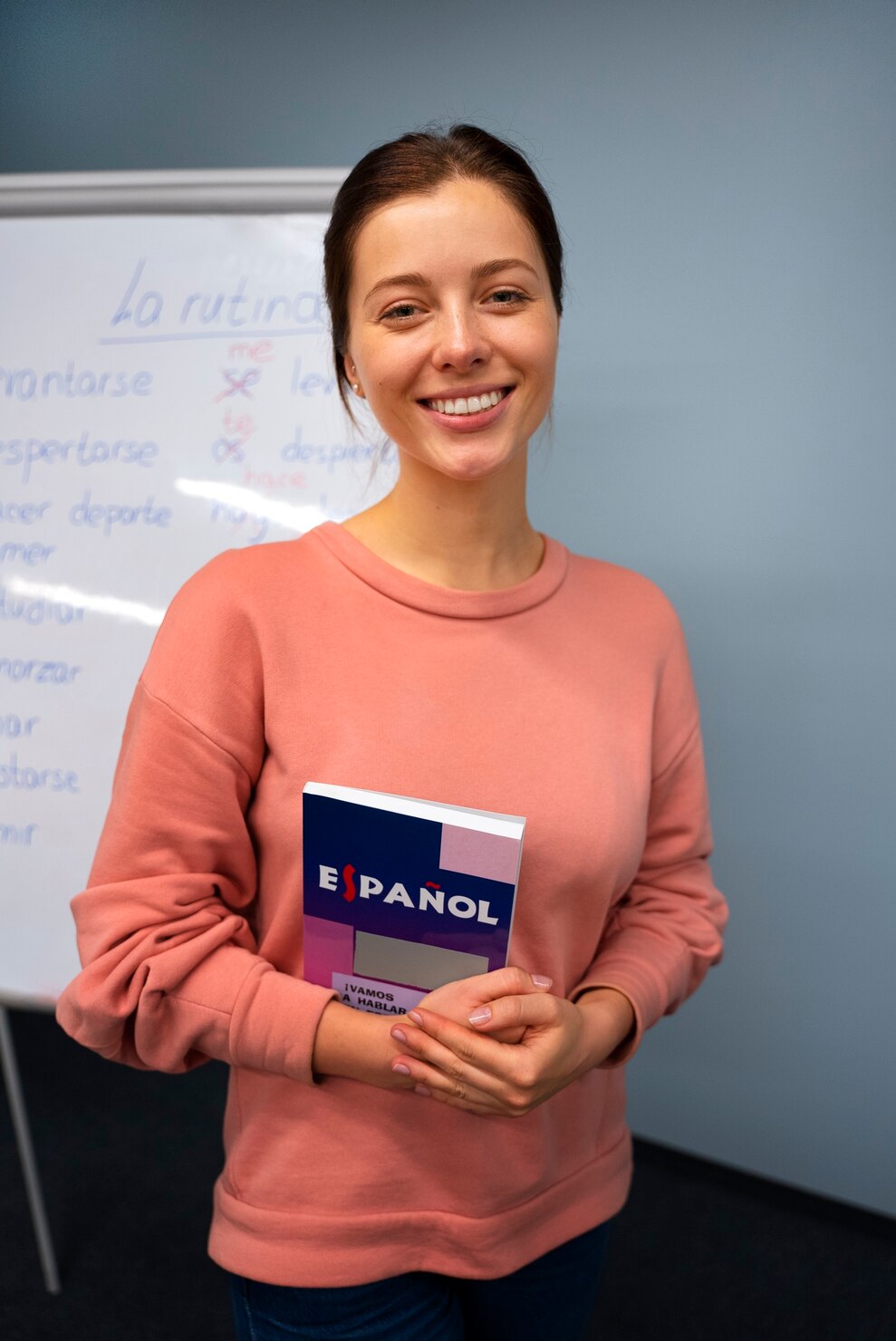
Keep the conversation going
Build one clear answer, listen for a detail, and use that detail in your next question.
Listen for something specific
- Answer. Say one complete sentence.
- Extend. Add a detail about when, where or why.
- Ask. Use a detail from your partner’s reply.
— Estudio en la biblioteca los sábados.
— ¿A qué hora vas a la biblioteca?
When you miss a detail, ask for the piece you need. ¿El sábado o el domingo? gives your partner something concrete to clarify.
Pick a topic for two minutes
Daily routines
¿Dónde estudias? ¿A qué hora empiezas?
Use two present-tense verbs and give a place or time.
Weekend plans
¿Qué vas a hacer el fin de semana? ¿Con quién vas a ir?
Use ir a twice and ask one follow-up.
Food and family traditions
¿Qué plato preparan en tu casa para una ocasión especial? ¿Quién lo prepara?
Give a detail about the person, the ingredients or the occasion.
About the author
About Me: Your Guide on the Journey to Spanish Fluency
Hi, I’m Luz — educator, lifelong learner, and founder of Learn Spanish Forever.
If you’re here, chances are you’ve tried learning Spanish before—maybe more than once. Maybe you’ve used apps, taken a class, or even grew up hearing Spanish at home… but fluent conversations still feel out of reach. I get it—because I’ve been there too.
Years ago when I set out to learn English I didn’t have time to waste, and I didn’t want gimmicks—I wanted results. So I committed to learn it, focused on fundamentals, and stayed consistent. In just three months, I saw massive progress. Since then, I have worn various hats as Spanish instructor, translator, tutor, and Spanish books author.
That experience transformed the way I view language learning—and it’s the foundation for Learn Spanish Forever.
This blog isn’t about shortcuts. It’s about strategy, structure, and staying power.
I created Learn Spanish Forever as a companion hub type of place for my current students and readers of my books, and for any motivated learner—who happens to land on my site. If you are done dabbling and ready to actually learn Spanish, whether you’re starting from zero or trying to finally break past a plateau, this space is for you.
Here, you’ll find:
- Step-by-step guidance rooted in real learning science.
- Lessons that make grammar make sense (yes, even the tricky parts).
- Mindset strategies to keep you going, especially when it gets hard.
- Motivational stories to remind you why you started.
- Tools to measure your progress and celebrate every win.
What I learned In My Own Journey:
- Mistakes are proof you’re learning.
- Discipline and commitment beat talent.
- Small wins build momentum and keep going.
If you’re ready to learn Spanish for good, this is the practice hub and book companion for you.
To your success!
Let’s learn Spanish, forever.
Culture & variation
Spanish across regions
Compare a few regional patterns. Customs and speech also vary within each country, community and family.
Listen / Pronunciation
Listen to casa and caza
They sound alike in Latin American Spanish and in some parts of Spain. In much of Spain, the z in caza sounds like the English th in “thin.”
Notice / Word choice
Three words for a computer
La computadora is common across much of Latin America, while el computador is more common in Chile and Colombia. In Spain, you’ll generally hear el ordenador.
Compare / Food customs
At the table
In Spain, going out for tapas can mean sharing small portions with friends. In Mexico, corn tortillas and tamales are everyday foods and can also feature in Day of the Dead offerings.
Idioms in context — Read the exchange
After you’ve studied the verbs, read each exchange aloud and change one detail to make it your own.
Tener ganas de
To feel like doing something.
¿Tienes ganas de salir?
Hoy tengo ganas de leer en casa.
Show translation
“Do you feel like going out?” “Today I feel like reading at home.”
Echar una mano
To lend a hand. Use it in informal conversation.
¿Me echas una mano con estas cajas?
Claro. ¿Dónde las pongo?
Show translation
“Can you give me a hand with these boxes?” “Sure. Where should I put them?”
Estar en las nubes
To be daydreaming or distracted.
¿Escuchaste la pregunta?
No, estaba en las nubes.
Show translation
“Did you hear the question?” “No, I was daydreaming.”
The worksheet shelf
These worksheet listings are reserved for future downloads. In the meantime, you can use the linked lessons and practice activities.
SER vs. ESTAR Review
Sentence completion and a space to explain your choice.
COMING SOON
Conversation Practice Sheet
Partner prompts and room to write follow-up questions.
COMING SOON